Tuesday, July 8, 2008

McCain on Energy

We’re back! We are restarting our blogging after a break. This election cycle, both major party candidates are talking about energy and we can expect vigorous debate about this area through the Fall.

Consequently, the primary focus of these next blogs will be on analyzing the positions of the presidential candidates through our 3 dimensions (business, technology, politics). We will ask our friends to contribute to specific topics and we will update our discussion as the campaigns release new information. First up is John McCain.


"In recent days I have set before the American people an energy plan, the Lexington Project -- named for the town where Americans asserted their independence once before. And let it begin today with this commitment: In a world of hostile and unstable suppliers of oil, this nation will achieve strategic independence by 2025." – John McCain, June 2008

Key climate change positions

1) Develop a cap and trade system on GHG emissions:

  • GHG targets: for 2012, reduce emissions to 2005 levels – for 2020, reduce to 1990 levels
  • All commercial businesses would have to take part, small business would be exempt
  • Create a strategic carbon reserve to be used as a source of credit during times of economic distress

2) Increase federal support for research and development, focusing on: Carbon capture and sequestration, nuclear power, battery development and support for commercialization of technologies

3) Engage with the United Nations and the international community to coordinate climate change related initiatives

4) $300 million prize to inventor of battery which “leapfrogs” commercially available hybrids – Announced June 23

5) Support for offshore oil drilling – Announced late June

Analysis of positions

All of McCain’s policy proposals would help create a US energy policy that is more sustainable (i.e. reduced oil consumption, reduced foreign oil imports, reduced greenhouse gas emissions) than the present one. All policies have pros and cons and below we will analyze these through the 3 lenses.

Business

Cap and trade will require large up front investments in all industries to install carbon absorbers and cleaners in burners. Some companies and indeed some industries will choose to leave the United States and set up in countries without carbon restrictions. The policy will also lead to the creation of a new industry to reduce carbon emissions – companies that will measure carbon emissions, verify reductions levels, manufactures of cleaner burning material, energy consultants, etc.

Technology

A $300 million dollar prize, though a significant amount of money, is unlikely to significantly affect the development of new batteries. Technology developments in the energy industry have been a result of a number of independent actors working separately but in related clusters - There is no one single “inventor”. For example, A123 is a successful Boston-area company which was based on technology from MIT labs and later raised funding from VCs. Consequently, a successful policy must incentive all of the follow people: Research labs at major universities, graduate and post-graduate students in these labs, entrepreneurs to launch the company, venture capitalists to invest in them, customers to buy the product.

Federal support of research and development is key. The primary focus of federal dollars should be DoE-related labs and major research universities. Ideally, this support should be coordinated with the private sector to maximize effect. (such as BP partnering with DoE and universities to develop the Energy Biosciences Institute at Berkeley)

Politics

The cap and trade system is good politics, as it will reduce overall emissions and does not have the perception of being anti-consumer like a carbon tax (because it directly will lead to increased prices). However, a carbon tax is more fair (a fixed price per ton of carbon charged to all polluters) and easier to implement (setting the initial carbon allocation per company in a cap and trade system is tricky to not reward big polluters).

The battery prize is also good politics because it is an easy policy to explain and it brings to mind positive memories of teams of young students who create a company in their garage.

Offshore drilling is more complicated from a policy and politics perspective. Offshore drilling is more relevant in California and states that border the Gulf of Mexico. The high price of gas in the summer of 2008 has led many people to support measures which reduce or appear to reduce the price, and accept potential environmental problems. So politically, it may be a net winner. From a policy perspective, (i.e. will this result in reduced imports of oil?), this is probably negative. Allowing companies to drill doesn’t mean they actually could - today a significant percentage of oil fields that are available for drilling are not being used for this. Additionally, even if oil companies decided to drill, it will take many years (perhaps decades) to bring oil on stream.

To date, McCain has not stated a position on biofuels.

Monday, August 13, 2007

Ethanol

One of the areas receiving the most coverage is ethanol. Given its prominence, we decided one of our first postings should be about this topic.

A few facts which stand out about the ethanol industry today in the US.

- There are about 7 billion gallons of ethanol produced and consumed in the US, while total gasoline consumption is around 150 billion gallons a year. (ethanol represents 5% of total)
- There are currently about 6 million Flex Fuel Vehicles (FFVs) on the road out of a total of 230 million cars on US highways (3% of total)
- There are 1,000 E85 pumps in the US, out of a total of around 200,000. (0.5% of total)
- Most of the ethanol produced is consumed as E10

So there is an order of magnitude difference in the availability of E85 fuel stations relative to the availability of ethanol. Fuel stations are the “retail outlets” of the fuel industry, without them fuel doesn’t get to market. A true ethanol (or other non-fossil based fuel) economy will not develop until that happens.

It is not a chicken or egg problem anymore, there are enough cars on the road that can run on E85. The bottlenecks are more complicated and subtle – that the FFVs are owned by users who don’t know or don’t care that they can run on E85, that the FFVs are located in parts of the country which don’t have E85 pumps (for example, today there is not a single active E85 station in Massachusetts).

Today, nearly all of the ethanol produced is mixed with gasoline, to replace MTBE, and sold at regular fuel pumps (E10). Thus, in an ironic twist, today the primary buyers of ethanol are oil companies. E10 can run in a normal car, so the billions of gallons of ethanol produced today are effectively still being used within the oil economy.

Projections are that towards the end of next year, US production of ethanol will reach 10% of total consumption. Adrian went to a biotechnology conference in Illinois a few weeks ago. His view was that there is a lot of pessimism among participants about the ability of the US economy to absorb ethanol produced beyond that 10%. The prime reason for this is that E85 infrastructure has not been set up - transporation and pumps.

So what happens the day after 10% is reached. Can a normal car run on 15% ethanol? Yes. Unadjusted cars can run on E20 and potentially up to E30. What this means is that even if the E85 infrastructure is not set up by end of next year, the excess ethanol could potentially still be put to use.

Overview of E20/E30 and E85:


None of this will ever be relevant unless we can produce enough ethanol. Corn prices are already being affect by the current production of corn ethanol, so another way has to be developed to go beyond E10/E20.

Wednesday, July 11, 2007

Welcome

Dear reader,

There is an ongoing discussion about energy and sustainability. One piece of this debate, to pull out an example, is whether we need to reduce the amount of oil that we use - how do we do this, what are the effects, is this good or bad for the economy, for our society?

The 3 of us have been discussing energy-related issues together for the 2 years that we have been graduate students at MIT and Harvard – during this time we have been thinking of ways we can contribute to the debate. What we bring is knowledge of what is happening in the technical, business and policy worlds related to energy – because of energy’s central position in our modern society, meaningful change will only happen when these three critical sectors are engaged simultaneously. Our blog will be a place to discuss the interaction of these 3 areas for people who have a stake or an interest in the development of the renewable energy sector. We also want to expose people to exciting developments occurring at Harvard and MIT. Lastly, we hope to create a platform to which our friends and acquaintances who are experts in these areas can contribute.

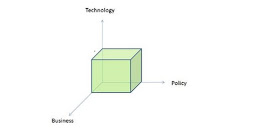
Because these three dimensions– technology, business, policy – and their interactions will define the future development of energy, we have decided to call the blog EnergyCubed.

Adrian Fay is a Research Scientist at Greg Stephanopolous’s lab at MIT. He is involved in various agricultural businesses in Argentina and the USA. Jason Fuller is a Chemical Engineering PhD Candidate in Robert Langer's lab at MIT with a focus on biotechnology. Lawrence A Walmsley is a joint degree candidate at the MIT Sloan School of Management and the Harvard Kennedy School of Government with a focus on clean energy entrepreneurship. The 3 of us organized an MIT conference on entrepreneurship in Buenos Aires, Argentina in 2006.

Best,
Adrian, Jason, Lawrence